

Table of Contents
- What You'll Need Before You Start
- How to Sanitize Makeup After Cold Sores: Step-by-Step
- When to Throw Away Makeup After a Cold Sore
- How to Clean Lipstick After a Cold Sore
- Safe Makeup Application During a Cold Sore Outbreak
- Common Mistakes to Avoid
- Post-Outbreak Recovery and Prevention
- Frequently Asked Questions
Last Updated: September 30, 2026
What You'll Need Before You Start
Cold sores are caused by the herpes simplex virus, most often HSV-1, which can survive on surfaces long enough to cause reinfection. This guide from LipCur covers exactly how to sanitize makeup after cold sores, step by step. The short version: anything that touched an active lesion needs to be isolated, cleaned, or thrown out. Here is what to gather.
- Isopropyl alcohol (70% strength) for hard tools and surfaces
- Antibacterial soap and warm water
- Disposable applicators (cotton swabs, sponge-tip wands)
- Paper towels you can toss after each use
- A small bin or bag for products you plan to discard
- A face wash routine you already trust
How to Sanitize Makeup After Cold Sores: Step-by-Step
Sanitizing makeup after a cold sore means separating what touched the sore, cleaning the tools that can survive alcohol, and throwing out anything porous. Skip a step and you risk reinfecting the same spot or spreading the virus.
Total time: 20-30 minutes Difficulty: Beginner
Here is the full process.
Step 1: Isolate Contaminated Products
Pull every product that touched your lips or the sore area: lipstick, lip balm, lip gloss, lip liner, and any brush or sponge used near your mouth. Set them apart from your clean makeup. Do not dip a contaminated wand back into a shared product, and keep a lip brush used on the sore in quarantine until it is cleaned.
Step 2: Clean Brushes and Tools
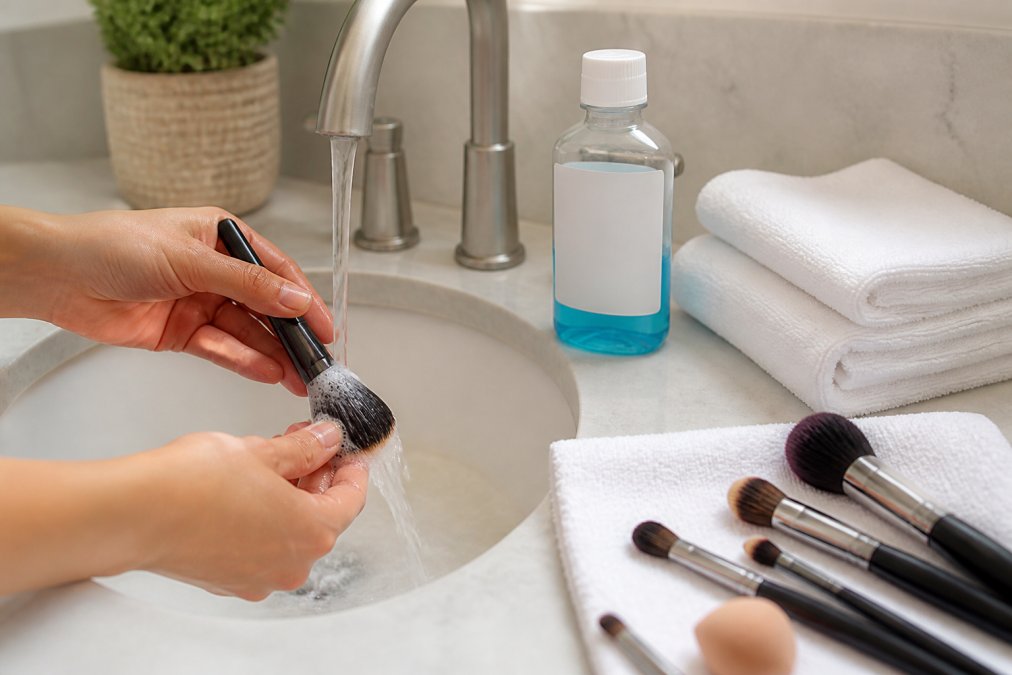
Wash brushes with antibacterial soap and warm water, working the soap into the bristles and rinsing until the water runs clear. For hard tools like tweezers, metal spatulas, or brush handles, wipe with 70% isopropyl alcohol and let them air dry completely. Damp tools grow bacteria, and bacteria on a healing lesion is a bad combination.
- Wash bristles until water runs clear
- Wipe metal tools with 70% isopropyl alcohol
- Air dry fully, never towel-dry into a drawer
Step 3: Disinfect Surfaces and Hands
Wipe down your vanity, mirror edges, and any surface the product touched. Use alcohol or a disinfecting wipe.
When to Throw Away Makeup After a Cold Sore
The keep-or-toss call comes down to one property: porosity. HSV-1 is a lipid-enveloped virus, fairly fragile on hard, non-porous surfaces but able to persist in the microscopic crevices of porous materials where a wipe, spray, or dip in alcohol never reaches. That fact drives every decision below.
| Product | Action | Why |
|---|---|---|
| Lipstick bullet (cream, satin, matte) | Discard | Porous wax matrix; the bullet surface and the collar both hold virus |
| Lip gloss (doe-foot or sponge-tip wand) | Discard | The wand is the worst offender, it goes back into the tube every use |
| Lip balm stick | Discard | Same porous wax issue as lipstick; the twist mechanism traps residue |
| Lip balm pot or tin | Discard | Finger or applicator dips repeatedly into a shared reservoir |
| Lip liner pencil (wood barrel) | Sharpen to sanitize | A fresh sharpen removes the contaminated outer layer |
| Lip liner (retractable plastic) | Discard | Cannot be sharpened; the plastic tip holds residue |
| Liquid lipstick | Discard | Liquid formula plus a doe-foot applicator equals a sealed viral reservoir |
| Lip tint or stain (rollerball) | Discard | Rollerball contacts the lesion and re-dips |
| Foundation or concealer (pump) | Keep if untouched | No lesion contact; pump keeps product isolated |
| Foundation or concealer (wand or doe-foot) | Discard if it touched the sore | The applicator is the contamination point |
| Powder blush, bronzer, eyeshadow | Keep if untouched | Dry powders are poor viral hosts; no moisture, no direct contact |
| Cream blush or cream contour | Discard if finger or sponge touched the sore | Cream formulas hold moisture and residue |
| Mascara | Keep | No lesion contact; do not share, and replace every three months anyway |
| Eyeliner pencil | Sharpen to sanitize | Same logic as lip liner |
| Liquid eyeliner | Keep if untouched | Do not share the tip |
| Makeup brushes (synthetic) | Clean | Non-porous fibers survive soap and alcohol |
| Makeup brushes (natural hair) | Clean, then judge | Natural bristles are more porous; if the brush touched the open sore, replace it |
| Beautyblender or makeup sponge | Discard | Open-cell foam cannot be disinfected |
| Silicone applicators | Clean | Non-porous, wipe with 70% isopropyl alcohol |
| Metal tools (tweezers, spatulas, lash curler) | Clean | Non-porous, alcohol-safe |
The cost math
A drugstore lip gloss runs a few dollars, a department-store lipstick $25 to $40, and a cream foundation $40 or more. Replacing a $30 lipstick is cheaper than a second outbreak, a doctor visit, or a prescription antiviral copay. When in doubt on a porous product that touched the lesion, toss it. The exception is a pencil you can sharpen or a hard tool you can wipe.
How to Clean Lipstick After a Cold Sore
Start with the honest answer: most lipstick should be thrown out after a cold sore. The bullet is a porous wax matrix, and the virus can sit below the surface where a wipe, spray, or dip in alcohol never reaches. Cleaning reduces risk; it does not eliminate it. That said, if the tube was expensive or sentimental, here is the most rigorous home method available.
Why 70% isopropyl alcohol, not 91%
Higher concentration is not better. A 91% or 99% solution coagulates the virus's outer proteins so fast it forms a protective shell, and the alcohol never penetrates to the core. A 70% solution has enough water to slow that coagulation, letting the alcohol denature the viral envelope. The CDC and most clinical disinfection protocols specify 70% for exactly this reason.
The cleaning protocol
- Wipe the top layer. Use a clean tissue or cotton pad to remove the visible surface of the bullet. This removes the bulk of the contamination but not what is below.
- Spray or dip the bullet in 70% isopropyl alcohol. Spray until the surface is visibly wet, or dip the top quarter-inch into a small cup of alcohol.
- Let it sit wet for at least 30 seconds. Contact time matters more than concentration. A quick wipe-and-go does almost nothing.
- Air dry completely. Do not wipe it dry. Let the alcohol evaporate on its own. This takes about a minute.
- Scrape the top layer off with a clean spatula. A metal cosmetic spatula, wiped with alcohol first, removes the top 1-2 millimeters of product. This is the step most people skip and the one that matters most.
- Sharpen wooden lip and eye pencils. The outer layer of a pencil is where contamination lives. A fresh sharpen removes it in seconds. Retractable plastic liners cannot be sharpened, discard those.
- Wash any lip brush before it touches anything else. Antibacterial soap and warm water, worked into the bristles, rinsed until the water runs clear, then air dried.
What this method does not do
It does not sterilize the inside of the tube, reach the product below the top layer, or make a gloss wand safe, the sponge tip is a sealed reservoir. If you used the lipstick directly on the sore and the tube has been sitting warm, the risk is higher than the protocol can offset.
The trade-off
If the lipstick was a $6 drugstore tube, replace it, the protocol costs more in time and alcohol than the product is worth. If it was a $35 department-store bullet you cannot easily replace, the protocol above is a reasonable risk-reduction step, but treat the product as suspect for the next few weeks and watch for tingling near the same spot.
Safe Makeup Application During a Cold Sore Outbreak
You can wear makeup during an outbreak. You just cannot apply it the way you normally do.
- Apply lip products with a disposable wand, never directly from the tube
- Wash hands before and after application
- Do not double-dip a wand back into a product
- Use a fresh applicator each time you touch up
- Keep the sore covered only if a doctor says it is safe
Common Mistakes to Avoid
Most people make the same errors after a cold sore, and each one extends the outbreak or sets up the next.
- Wiping instead of discarding. A tissue wipe does nothing to a porous product.
- Reusing the same lip brush. If it touched the sore, it needs a full wash before it touches anything else.
- Sharing products. No borrowing lip balm, no lending a gloss, no exceptions during an outbreak.
- Skipping hand washing. You touch the sore, then touch your eye or a clean product. That is how it spreads.
- Ignoring early symptoms. The tingling stage is when treatment works best. Waiting until the sore is visible wastes the window.
Post-Outbreak Recovery and Prevention
Once the sore has fully healed, rebuild your routine slowly.
For prevention, keep a few habits in place:
- Sanitize brushes every one to two weeks
- Replace lip products every three to six months
- Never share lip or eye products
- Treat tingling early, before a lesion forms
Frequently Asked Questions
Can I disinfect my lipstick after having a cold sore?
You can disinfect the outside of the lipstick bullet by wiping it with a cotton pad soaked in 70% isopropyl alcohol, then shaving off the top layer with a clean, sanitized knife. However, the virus can survive inside the product, so if the lipstick touched an active sore, it's safer to throw it away. For future outbreaks, use disposable applicators to avoid contaminating the product.
How long does HSV-1 stay on makeup products?
HSV-1 can survive on hard surfaces like plastic makeup cases for up to 4 hours, but on porous items like lipstick or cream products, it may persist for several days. The exact time depends on temperature, moisture, and the type of surface. To be safe, discard any product that directly touched a cold sore, and clean tools thoroughly with isopropyl alcohol.
Can you put makeup over cold sores?
You can apply makeup over a cold sore if you use safe techniques: always use disposable applicators, never double-dip, and avoid touching the sore with your fingers. Cover the sore with a small bandage or cold sore patch before applying foundation. Remove all makeup gently at the end of the day and wash your hands before and after.
When should I throw away makeup after a viral infection?
Throw away any makeup that directly contacted the infected area, such as lipstick, lip gloss, and lip balm, as well as any tools that are difficult to sanitize completely. If the product is a powder or pencil, you can sanitize it by wiping with alcohol. For liquid or cream products, disposal is the safest option to prevent reinfection.